Archives

Showing posts with label stars. Show all posts

Thursday, June 23, 2011

Pandora's Cluster Revealed

One of the most complicated and dramatic collisions between galaxy clusters ever seen is captured in this new composite image. This collision site, known officially as Abell 2744, has been dubbed "Pandora's Cluster" because of the wide variety of different structures seen. Data from NASA's Chandra X-ray Observatory are colored red, showing gas with temperatures of millions of degrees. In blue is a map showing the total mass concentration (mostly dark matter) based on data from the Hubble Space Telescope (HST), the European Southern Observatory's Very Large Telescope (VLT), and the Japanese Subaru telescope. Optical data from HST and VLT also show the constituent galaxies of the clusters.

The "core" region shows a bullet-shaped structure in the X-ray emitting hot gas and a separation between the hot gas and the dark matter. (As a guide, local peaks in the distribution of hot gas and overall matter in the different regions are shown with red and blue circles respectively). This separation occurs because electric forces between colliding particles in the clouds of hot gas create a friction that slows them down, while dark matter is unaffected by such forces.

In the Northwest ("NW") region, a much larger separation is seen between the hot gas and the dark matter. Surprisingly, the hot gas leads the "dark" clump (mostly dark matter) by about 500,000 light years. This unusual configuration may require a slingshot scenario, as suggested previously by scientists, to fling the hot gas ahead of the dark matter during an earlier interaction. In the North ("N") and the West ("W") two additional examples of hot gas separated from dark matter may be visible. The latter appears to exhibit the largest separation seen to date between hot gas and dark matter.

The authors of this study retraced the details of the collision, and deduce that at least four different galaxy clusters coming from a variety of directions were involved. To understand this history, it was crucial to map the positions of all three types of matter in Abell 2744. Although the galaxies are bright, they make up less than 5% of the mass in Abell 2744. The rest is hot gas (around 20%) visible only in X-rays, and dark matter (around 75%), which is completely invisible.
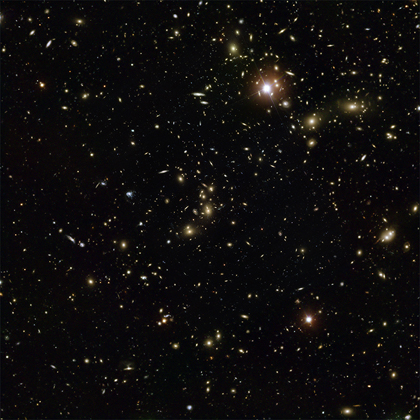
Dark matter is particularly elusive as it does not emit, absorb or reflect light, but only makes itself apparent through its gravitational attraction. To pinpoint the location of this mysterious substance the team used a phenomenon known as gravitational lensing. This is the bending of light rays from distant galaxies as they pass through the gravitational field present in the cluster. The result is a series of telltale distortions in the images of galaxies in the background of optical observations. By carefully plotting the way that these images are distorted, a map is constructed of where the mass -- and hence the dark matter -- actually lies (shown in blue).

Galaxy clusters are the largest gravitationally bound objects in the Universe and have become powerful tools in cosmology studies. Further studies of Abell 2744 may provide a deeper understanding of the way that these important objects grow and provide new insight into the properties of dark matter.

Image credit: X-ray: NASA/CXC/ITA/INAF/J. Merten et al. Lensing: NASA/STScI; NAOJ/Subaru; ESO/VLT Optical: NASA/STScI/R. Dupke

Janet Anderson, 256-544-0034
Marshall Space Flight Center, Huntsville, Ala.
janet.l.anderson@nasa.gov

Megan Watzke 617-496-7998
Chandra X-ray Center, Cambridge, Mass.
m.watzke@cfa.harvard.edu
Read More >>

Friday, May 13, 2011

A Star-Formation Laboratory

The dwarf galaxy NGC 4214 is ablaze with young stars and gas clouds. Located around 10 million light-years away in the constellation of Canes Venatici (The Hunting Dogs), the galaxy's close proximity, combined with the wide variety of evolutionary stages among the stars, make it an ideal laboratory to research the triggers of star formation and evolution. This color image was taken using the Hubble Space Telescope's Wide Field Camera 3 in December 2009.

Image Credit: NASA/ESA/Hubble Heritage (STScI/AURA)-ESA/Hubble Collaboration
Read More >>

Tuesday, May 10, 2011

NASA Selects Classroom Teachers For SOFIA Science Flights

Trent J. Perrotto
Headquarters, Washington     
 
Cathy Weselby/Nick Veronico
Ames Research Center/SOFIA Science Center, Moffett Field, Calif.
 
MOFFETT FIELD, Calif. -- NASA has selected six teachers to work with scientists aboard the Stratospheric Observatory for Infrared Astronomy (SOFIA) during research flights in May and June. This is the first team of educators selected to participate in SOFIA's Airborne Astronomy Ambassadors program.

SOFIA is a highly modified Boeing 747SP aircraft fitted with a 100 inch (2.5 meter) diameter telescope. It analyzes infrared light to study the formation of stars and planets; chemistry of interstellar gases; composition of comets, asteroids and planets; and supermassive black holes at the center of galaxies. Infrared observations are optimal for studying low-temperature objects in space such as the raw materials for star and planet formation and for seeing through interstellar dust clouds that block light at visible wavelengths.

"Enabling educators to join SOFIA's scientific research and take that experience back to their schools and communities is a unique opportunity for NASA to enhance science and math education across the country," said John Gagosian, SOFIA program executive at agency headquarters in Washington. "More than 70 teachers flew on NASA's previous flying observatory, the Kuiper Airborne Observatory, from 1991 through 1995, and that program had long-lasting, positive effects on both the teachers and their students."

The six teachers selected for the SOFIA program submitted applications that included plans for taking their training and flight experience back to their classrooms.
The teachers selected are:
-- Marita Beard, Branham High School, San Jose, Calif.
-- Mary Blessing, Herndon High School, Herndon, Va.
-- Cris DeWolf, Chippewa Hills High School, Remus, Mich.
-- Kathleen Joanne Fredette, Desert Willow Intermediate School, Palmdale, Calif.
-- Theresa Paulsen, Mellen School District, Mellen, Wis.
-- Margaret Piper, Lincoln Way High School, Frankfort, Ill.

"We know teachers who participate in science research programs return inspired, and their students' engagement with technical subjects are measurably increased for many years afterward," said Dana Backman, manager of SOFIA's education and outreach programs. "Airborne Astronomy Ambassadors is an outstanding opportunity for NASA to reach out to both new and veteran teachers of science, technology, engineering and math to bring the excitement of real science research into the classroom and the community at large."

NASA's international partners in developing and operating SOFIA, the German Aerospace Center (DLR) and the German SOFIA Institute (DSI), will fly educators as well. The DLR and DSI plan to announce their first two ambassadors later this month.

SOFIA is a joint program between NASA and DLR in Bonn, Germany. The SOFIA program is managed at NASA's Dryden Flight Research Center, Edwards, Calif. The aircraft is based at the Dryden Aircraft Operations Facility in Palmdale, Calif. NASA's Ames Research Center in Moffett Field, Calif., manages the SOFIA science and mission operations in cooperation with the Universities Space Research Association in Columbia, Md., and DSI in Stuttgart, Germany.

NASA will host an online video chat about SOFIA with Project Scientist Pamela Marcum for approximately one hour at 1 p.m. EDT on Thursday, May 12. Participants will join a conversation about SOFIA’s first science flights, targets of opportunity, and plans for future flights. Based at Ames Research Center, Marcum is an expert on galaxy evolution and worked on the first extensive ultraviolet imaging of nearby galaxies. For more information on the chat and to participate, visit http://www.ustream.tv/channel/nasa-arc.

For more information about SOFIA, visit http://www.nasa.gov/sofia.

For information about SOFIA's science missions, visit http://www.sofia.usra.edu and http://www.dlr.de/en/sofia.

- end -
Read More >>

Monday, May 9, 2011

Comets WISE -- A Family Portrait

During its one-year mission, NASA's Wide-field Infrared Survey Explorer, or WISE, mapped the entire sky in infrared light. Among the multitudes of astronomical bodies that have been discovered by the NEOWISE portion of the WISE mission are 20 comets. This collage shows those 20 new comets together in a kind of family portrait.

The fuzzy background in each picture is due to random fluctuations in infrared light, primarily from dust in our own solar system. Stars cannot be seen because they were subtracted during the process of combining multiple WISE pictures to make this view centered on the moving comets.

Image Credit: NASA/JPL-Caltech/UCLA
Read More >>

Thursday, April 14, 2011

Hunting for the Milky Way's Heaviest Stars

Like looking for Easter eggs in a lawn of long grass, the hunt for the Milky Way's most massive stars takes persistence and sharp eyes. In their stellar search through our Galactic backyard, astronomers have used powerful telescopes sensitive to X-ray and infrared radiation to find evidence for a substantial population of X-ray emitting massive stars.

This image shows infrared data from NASA's Spitzer Space Telescope near the plane of the Milky Way galaxy. Both outlined boxes contain an artificially darkened view of the Spitzer data, to highlight a bright X-ray source (blue) detected at the center of each square with NASA's Chandra X-ray Observatory. Each X-ray source coincides with a strong infrared signal.

Analysis of the X-ray and infrared data, as well as optical and radio observations, reveals that these bright sources are, in fact, extremely massive stars. Two other massive stars have also been found near the plane of the Milky Way using similar methods. Deep observations from ESA's XMM-Newton also provided valuable information for these other two objects. All four of these stars are thought to be at least 25 times more massive than the Sun and lie between 7,500 and 18,000 light years from Earth. These stars are expected to last only a few million years and will end their lives with supernova explosions.

Finding these very massive stars is not easy. Dust and gas throughout the Milky Way obscures much of the view from optical telescopes near the plane of the galaxy. Infrared images suffer less obscuration but are extremely crowded with stars. However, these stellar behemoths shine brightly in X-ray light and easily stand out from their neighbors in Chandra images.

Why are these massive stars so bright in X-rays? Some massive stars have winds that blow material away from their surface at over 2 million miles per hour. If this high-speed material collides with the wind from a companion star, it is decelerated so suddenly that acts like it has collided with a Solar System-sized brick wall. The shock waves resulting from this enormous collision generate temperatures up to 100 million degrees, and produce copious amounts of X-rays.

These Chandra observations followed a survey of the plane of our Galaxy by the Advanced Satellite for Cosmology and Astrophysics (ASCA), a previous X-ray mission. This survey detected about 160 X-ray sources, but only a third of them could be definitively identified due to the limited spatial resolution of ASCA. Because Chandra's ability to resolve sources is significantly greater, much more precise positions could be obtained. This has allowed scientists to identify counterparts to the X-ray sources in other wavelengths. There are many other unidentified Galactic X-ray sources with X-ray properties similar to these four sources, so a large population of massive stars may remain to be discovered with future Chandra observations.

These results were published in the February 1st issue of The Astrophysical Journal in a paper led by Gemma Anderson (University of Sydney). Other authors included Bryan Gaensler (University of Sydney), David Kaplan (University of Wisconsin, Milwaukee), Bettina Posselt, Patrick Slane and Stephen Murray (Harvard-Smithsonian Center for Astrophysics, or CfA), Jon Mauerhan (California Institute of Technology), Robert Benjamin (University of Wisconsin, Whitewater), Crystal Brogan (National Radio Astronomy Observatory), Deepto Chakrabarty (Massachusetts Institute of Technology), Jeremy Drake (CfA), Janet Drew (University of Hertfordshire), Jonathan Grindlay and Jaesub Hong (CfA), Joseph Lazio (Naval Research Laboratory), Julia Lee (CfA), Danny Steeghs (University of Warwick), and Marten van Kerkwijk (University of Toronto).

Credit: X-ray: NASA/U. of Sydney/G.Anderson et al; IR: NASA/JPL-Caltech
Read More >>

Wednesday, April 13, 2011

NASA Telescopes Help Discover Surprisingly Young Galaxy

Trent Perrotto
Headquarters, Washington
 
Whitney Clavin
Jet Propulsion Laboratory, Pasadena, Calif.
 
Ray Villard
Space Telescope Science Institute, Baltimore, Md.
 
Larry O'Hanlon
W.M. Keck Observatory, Mauna Kea, Hawaii

WASHINGTON -- Astronomers have uncovered one of the youngest galaxies in the distant universe, with stars that formed 13.5 billion years ago, a mere 200 million years after the big bang. The finding addresses questions about when the first galaxies arose, and how the early universe evolved.

NASA's Hubble Space Telescope was the first to spot the newfound galaxy. Detailed observations from the W.M. Keck Observatory on Mauna Kea in Hawaii revealed the observed light dates to when the universe was only 950 million years old; the universe formed about 13.7 billion years ago.

Infrared data from both Hubble and NASA's Spitzer Space Telescope revealed the galaxy's stars are quite mature, having formed when the universe was just a toddler at 200 million years old.

"This challenges theories of how soon galaxies formed in the first years of the universe," said Johan Richard of the Centre de Recherche Astronomique de Lyon, Université Lyon 1 in France, lead author of a new study accepted for publication in the Monthly Notices of the Royal Astronomical Society. "It could even help solve the mystery of how the hydrogen fog that filled the early universe was cleared."

This galaxy is not the most distant ever observed, but it is one of the youngest to be observed with such clarity. Normally, galaxies like this one are extremely faint and difficult to study, but, in this case, nature has provided the astronomers with a cosmic magnifying glass. The galaxy's image is being magnified by the gravity of a massive cluster of galaxies parked in front of it, making it appear 11 times brighter. This phenomenon is called gravitational lensing.

"Without this big lens in space, we could not study galaxies this faint with currently available observing facilities," said co-author Eiichi Egami of the University of Arizona in Tucson. "Thanks to nature, we have this great opportunity to see our universe as it was eons ago."

The findings may help explain how the early universe became "reionized." At some point in our universe's early history, it transitioned from the so-called dark ages to a period of light, as the first stars and galaxies began to ignite. This starlight ionized neutral hydrogen atoms floating around in space, giving them a charge. Ultraviolet light could then travel unimpeded through what had been an obscuring fog.

The discovery of a galaxy possessing stars that formed only 200 million years after the big bang helps astronomers probe this cosmic reionization epoch. When this galaxy was developing, its hot, young stars would have ionized vast amounts of the neutral hydrogen gas in intergalactic space. A population of similar galaxies probably also contributed to this reionization, but they are too faint to see without the magnifying effects of gravitational lensing.

NASA's James Webb Space Telescope (JWST), scheduled to launch later this decade, will be able to see these faint galaxies lacking magnification. A successor to Hubble and Spitzer, JWST will see infrared light from the missing population of early galaxies. As a result, the mission will reveal some of our universe's best-kept secrets.

"Seeing a galaxy as it appeared near the beginning of the universe is an awe-inspiring feat enabled by innovative technology and the fortuitous effect of gravitational lensing," said Jon Morse, NASA's Astrophysics Division director at the agency's headquarters in Washington.

"Observations like this open a window across space and time, but more importantly, they inspire future work to one day peer at the stars that lit up the universe following the big bang."

For more information about Spitzer and Hubble, visit http://www.nasa.gov/spitzer and http://www.nasa.gov/hubble.

- end -
Read More >>

Tuesday, April 12, 2011

NASA Kepler Reaching into the Stars

We are entering a golden era for "stellar physics" – a term coined to describe research about the formation, evolution, interior and the atmospheres of stars. Thanks to a partnership forged among stellar astrophysics, scientists and NASA’s Kepler Mission, a goldmine of data is now available to support the world's efforts to detect planets in the habitable zone around other stars.

The Kepler photometric data is a measurement of light’s “brightness,” and provides an unprecedented opportunity for the emerging field of asteroseismology, the study of the internal structure of stars by observing minuscule pulsations in the star brightness. Asteroseismic research is giving insights into the fundamental properties of stars, including their mass, size, age and internal structure. Kepler enables studies of a large number of stars representing a broad range of types. This asteroseismic research will substantially improve our understanding of stellar evolution. It also will help determine the properties of stars that have planetary systems studied in the Kepler exoplanet program.

The Kepler Asteroseismic Science Consortium (KASC) pushes the envelope in this field of study. Using the unparalleled precision and quality of Kepler data, the KASC research is contributing to stellar astrophysics in profound ways. The consortium is comprised of more than 400 scientists and is led by the Danish Asteroseismology Centre in the Department of Physics and Astronomy at the University of Aarhus, Denmark.

The KASC recently presented new findings published in three papers in the journal Science. In combination, these latest results illustrate the power of the Kepler Space Telescope to probe the internal structure of distant stars.
Read More >>