Archives

Showing posts with label chandra x-ray observatory. Show all posts

Thursday, June 23, 2011

Pandora's Cluster Revealed

One of the most complicated and dramatic collisions between galaxy clusters ever seen is captured in this new composite image. This collision site, known officially as Abell 2744, has been dubbed "Pandora's Cluster" because of the wide variety of different structures seen. Data from NASA's Chandra X-ray Observatory are colored red, showing gas with temperatures of millions of degrees. In blue is a map showing the total mass concentration (mostly dark matter) based on data from the Hubble Space Telescope (HST), the European Southern Observatory's Very Large Telescope (VLT), and the Japanese Subaru telescope. Optical data from HST and VLT also show the constituent galaxies of the clusters.

The "core" region shows a bullet-shaped structure in the X-ray emitting hot gas and a separation between the hot gas and the dark matter. (As a guide, local peaks in the distribution of hot gas and overall matter in the different regions are shown with red and blue circles respectively). This separation occurs because electric forces between colliding particles in the clouds of hot gas create a friction that slows them down, while dark matter is unaffected by such forces.

In the Northwest ("NW") region, a much larger separation is seen between the hot gas and the dark matter. Surprisingly, the hot gas leads the "dark" clump (mostly dark matter) by about 500,000 light years. This unusual configuration may require a slingshot scenario, as suggested previously by scientists, to fling the hot gas ahead of the dark matter during an earlier interaction. In the North ("N") and the West ("W") two additional examples of hot gas separated from dark matter may be visible. The latter appears to exhibit the largest separation seen to date between hot gas and dark matter.

The authors of this study retraced the details of the collision, and deduce that at least four different galaxy clusters coming from a variety of directions were involved. To understand this history, it was crucial to map the positions of all three types of matter in Abell 2744. Although the galaxies are bright, they make up less than 5% of the mass in Abell 2744. The rest is hot gas (around 20%) visible only in X-rays, and dark matter (around 75%), which is completely invisible.
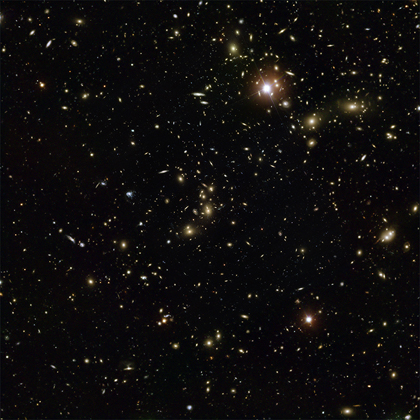
Dark matter is particularly elusive as it does not emit, absorb or reflect light, but only makes itself apparent through its gravitational attraction. To pinpoint the location of this mysterious substance the team used a phenomenon known as gravitational lensing. This is the bending of light rays from distant galaxies as they pass through the gravitational field present in the cluster. The result is a series of telltale distortions in the images of galaxies in the background of optical observations. By carefully plotting the way that these images are distorted, a map is constructed of where the mass -- and hence the dark matter -- actually lies (shown in blue).

Galaxy clusters are the largest gravitationally bound objects in the Universe and have become powerful tools in cosmology studies. Further studies of Abell 2744 may provide a deeper understanding of the way that these important objects grow and provide new insight into the properties of dark matter.

Image credit: X-ray: NASA/CXC/ITA/INAF/J. Merten et al. Lensing: NASA/STScI; NAOJ/Subaru; ESO/VLT Optical: NASA/STScI/R. Dupke

Janet Anderson, 256-544-0034
Marshall Space Flight Center, Huntsville, Ala.
janet.l.anderson@nasa.gov

Megan Watzke 617-496-7998
Chandra X-ray Center, Cambridge, Mass.
m.watzke@cfa.harvard.edu
Read More >>

Thursday, June 16, 2011

Chandra Deep Field South

This composite image from NASA's Chandra X-ray Observatory and Hubble Space Telescope (HST) combines the deepest X-ray, optical and infrared views of the sky. Using these images, astronomers have obtained the first direct evidence that black holes are common in the early Universe and shown that very young black holes grew more aggressively than previously thought.

Astronomers obtained what is known as the Chandra Deep Field South (CDFS) by pointing the telescope at the same patch of sky for over six weeks of time. The composite image shows a small section of the CDFS, where the Chandra sources are blue, the optical HST data are shown in green and blue, and the infrared data from Hubble are in red and green.

The new Chandra data allowed astronomers to search for black holes in 200 distant galaxies, from when the Universe was between about 800 million and 950 million years old. These distant galaxies were detected using the HST data and the positions of a subset of them are marked with the yellow circles (roll your mouse over the image above).

The rest of the 200 galaxies were found in other deep HST observations located either elsewhere in the CDFS or the Chandra Deep Field North, a second ultra- deep Chandra field in a different part of the sky.

None of the galaxies was individually detected with Chandra, so the team used a technique that relied on Chandra's ability to very accurately determine the direction from which the X-rays came to add up all the X-ray counts near the positions of these distant galaxies. The two "stacked" images resulting from this analysis are on the right side of the graphic, where the bottom image shows the low-energy X- rays and the top image has the high-energy X-rays. Statistically significant signals are found in both images.

These results imply that between 30% and 100% of the distant galaxies contain growing supermassive black holes. Extrapolating these results from the relatively small field of view that was observed to the full sky, there are at least 30 million supermassive black holes in the early Universe. This is a factor of 10,000 larger than the estimated number of quasars in the early Universe.

The stronger signal in high-energy X-rays implies that the black holes are nearly all enshrouded in thick clouds of gas and dust. Although copious amounts of optical light are generated by material falling onto the black holes, this light is blocked within the core of the black hole's host galaxy and is undetectable by optical telescopes. However, the high energies of X-ray light can penetrate these veils, allowing the black holes inside to be studied.

Image credit: X-ray: NASA/CXC/U.Hawaii/E.Treister et al; Infrared: NASA/STScI/UC Santa Cruz/G.Illingworth et al; Optical: NASA/STScI/S.Beckwith et al
Read More >>

Wednesday, June 15, 2011

NASA'S Chandra Finds Massive Black Holes Common In Early Universe

Trent J. Perrotto                               
Headquarters, Washington
 
Janet Anderson
Marshall Space Flight Center, Ala.                

Megan Watzke                         
Chandra X-ray Center, Cambridge, Mass.
 
WASHINGTON -- Using the deepest X-ray image ever taken, astronomers found the first direct evidence that massive black holes were common in the early universe. This discovery from NASA's Chandra X-ray Observatory shows that very young black holes grew more aggressively than previously thought, in tandem with the growth of their host galaxies.

By pointing Chandra at a patch of sky for more than six weeks, astronomers obtained what is known as the Chandra Deep Field South (CDFS). When combined with very deep optical and infrared images from NASA's Hubble Space Telescope, the new Chandra data allowed astronomers to search for black holes in 200 distant galaxies, from when the universe was between about 800 million to 950 million years old.

"Until now, we had no idea what the black holes in these early galaxies were doing, or if they even existed," said Ezequiel Treister of the University of Hawaii, lead author of the study appearing in the June 16 issue of the journal Nature. "Now we know they are there, and they are growing like gangbusters."

The super-sized growth means that the black holes in the CDFS are less extreme versions of quasars -- very luminous, rare objects powered by material falling onto supermassive black holes. However, the sources in the CDFS are about a hundred times fainter and the black holes are about a thousand times less massive than the ones in quasars.

The observations found that between 30 and 100 percent of the distant galaxies contain growing supermassive black holes. Extrapolating these results from the small observed field to the full sky, there are at least 30 million supermassive black holes in the early universe. This is a factor of 10,000 larger than the estimated number of quasars in the early universe.

"It appears we've found a whole new population of baby black holes," said co-author Kevin Schawinski of Yale University. "We think these babies will grow by a factor of about a hundred or a thousand, eventually becoming like the giant black holes we see today almost 13 billion years later."

A population of young black holes in the early universe had been predicted, but not yet observed. Detailed calculations show that the total amount of black hole growth observed by this team is about a hundred times higher than recent estimates.

Because these black holes are nearly all enshrouded in thick clouds of gas and dust, optical telescopes frequently cannot detect them. However, the high energies of X-ray light can penetrate these veils, allowing the black holes inside to be studied.

Physicists studying black holes want to know more how the first supermassive black holes were formed and how they grow. Although evidence for parallel growth of black holes and galaxies has been established at closer distances, the new Chandra results show that this connection starts earlier than previously thought, perhaps right from the origin of both.

"Most astronomers think in the present-day universe, black holes and galaxies are somehow symbiotic in how they grow," said Priya Natarajan, a co-author from Yale University. "We have shown that this codependent relationship has existed from very early times."

It has been suggested that early black holes would play an important role in clearing away the cosmic "fog" of neutral, or uncharged, hydrogen that pervaded the early universe when temperatures cooled down after the Big Bang. However, the Chandra study shows that blankets of dust and gas stop ultraviolet radiation generated by the black holes from traveling outwards to perform this "reionization." Therefore, stars and not growing black holes are likely to have cleared this fog at cosmic dawn.

Chandra is capable of detecting extremely faint objects at vast distances, but these black holes are so obscured that relatively few photons can escape and hence they could not be individually detected. Instead, the team used a technique that relied on Chandra’s ability to accurately determine the direction from which the X-rays came to add up all the X-ray counts near the positions of distant galaxies and find a statistically significant signal.

NASA's Marshall Space Flight Center in Huntsville, Ala., manages the Chandra program for the agency's Science Mission Directorate in Washington. The Smithsonian Astrophysical Observatory controls Chandra's science and flight operations from Cambridge, Mass.

More information, including images and other multimedia, can be found at http://www.nasa.gov/chandra and http://chandra.si.edu.

- end -
Read More >>

Wednesday, May 25, 2011

Carina Nebula

This Chandra image shows the Carina Nebula, a star-forming region in the Sagittarius-Carina arm of the Milky Way a mere 7,500 light years from Earth. Chandra's sharp X-ray vision has detected over 14,000 stars in this region, revealed a diffuse X-ray glow, and provided strong evidence that massive stars have already self-destructed in this nearby supernova factory.

The lower energy X-rays in this image are red, the medium energy X-rays are green, and the highest energy X-rays are blue. The Chandra survey has a large field of 1.4 square degrees, made of a mosaic of 22 individual Chandra pointings. In total, this image represents 1.2 million seconds -- or nearly two weeks -- of Chandra observing time. A great deal of multi-wavelength data has been used in combination with this new Chandra campaign, including infrared observations from the Spitzer Space Telescope and the Very Large Telescope (VLT).

Several pieces of evidence support the idea that supernova production has already begun in this star-forming region. Firstly, there is an observed deficit of bright X-ray sources in Trumpler 15, suggesting that some of the massive stars in this cluster were already destroyed in supernova explosions. Trumpler 15 is located in the northern part of the image, as shown in a labeled version, and is one of ten star clusters in the Carina complex. Several other well known clusters are shown in the labeled image.

The detection of six possible neutron stars, the dense cores often left behind after stars explode in supernovas, provides additional evidence that supernova activity is ramping up in Carina. Previous observations had only detected one neutron star in Carina. These six neutron star candidates are too faint to be easily picked out in this large-scale image of Carina.

Image credit: NASA/CXC/Penn State/L. Townsley et al.
Read More >>

Thursday, April 14, 2011

Hunting for the Milky Way's Heaviest Stars

Like looking for Easter eggs in a lawn of long grass, the hunt for the Milky Way's most massive stars takes persistence and sharp eyes. In their stellar search through our Galactic backyard, astronomers have used powerful telescopes sensitive to X-ray and infrared radiation to find evidence for a substantial population of X-ray emitting massive stars.

This image shows infrared data from NASA's Spitzer Space Telescope near the plane of the Milky Way galaxy. Both outlined boxes contain an artificially darkened view of the Spitzer data, to highlight a bright X-ray source (blue) detected at the center of each square with NASA's Chandra X-ray Observatory. Each X-ray source coincides with a strong infrared signal.

Analysis of the X-ray and infrared data, as well as optical and radio observations, reveals that these bright sources are, in fact, extremely massive stars. Two other massive stars have also been found near the plane of the Milky Way using similar methods. Deep observations from ESA's XMM-Newton also provided valuable information for these other two objects. All four of these stars are thought to be at least 25 times more massive than the Sun and lie between 7,500 and 18,000 light years from Earth. These stars are expected to last only a few million years and will end their lives with supernova explosions.

Finding these very massive stars is not easy. Dust and gas throughout the Milky Way obscures much of the view from optical telescopes near the plane of the galaxy. Infrared images suffer less obscuration but are extremely crowded with stars. However, these stellar behemoths shine brightly in X-ray light and easily stand out from their neighbors in Chandra images.

Why are these massive stars so bright in X-rays? Some massive stars have winds that blow material away from their surface at over 2 million miles per hour. If this high-speed material collides with the wind from a companion star, it is decelerated so suddenly that acts like it has collided with a Solar System-sized brick wall. The shock waves resulting from this enormous collision generate temperatures up to 100 million degrees, and produce copious amounts of X-rays.

These Chandra observations followed a survey of the plane of our Galaxy by the Advanced Satellite for Cosmology and Astrophysics (ASCA), a previous X-ray mission. This survey detected about 160 X-ray sources, but only a third of them could be definitively identified due to the limited spatial resolution of ASCA. Because Chandra's ability to resolve sources is significantly greater, much more precise positions could be obtained. This has allowed scientists to identify counterparts to the X-ray sources in other wavelengths. There are many other unidentified Galactic X-ray sources with X-ray properties similar to these four sources, so a large population of massive stars may remain to be discovered with future Chandra observations.

These results were published in the February 1st issue of The Astrophysical Journal in a paper led by Gemma Anderson (University of Sydney). Other authors included Bryan Gaensler (University of Sydney), David Kaplan (University of Wisconsin, Milwaukee), Bettina Posselt, Patrick Slane and Stephen Murray (Harvard-Smithsonian Center for Astrophysics, or CfA), Jon Mauerhan (California Institute of Technology), Robert Benjamin (University of Wisconsin, Whitewater), Crystal Brogan (National Radio Astronomy Observatory), Deepto Chakrabarty (Massachusetts Institute of Technology), Jeremy Drake (CfA), Janet Drew (University of Hertfordshire), Jonathan Grindlay and Jaesub Hong (CfA), Joseph Lazio (Naval Research Laboratory), Julia Lee (CfA), Danny Steeghs (University of Warwick), and Marten van Kerkwijk (University of Toronto).

Credit: X-ray: NASA/U. of Sydney/G.Anderson et al; IR: NASA/JPL-Caltech
Read More >>